
🖤 Turmeric – The Golden Spice of Life


In the world of spices, turmeric shines bright. This golden-hued powder – made from the knobbly root of the Curcuma longa plant.
Kook’s Secrets: Turmeric – The Golden Spice of Life
Introduction
In the world of spices, turmeric shines brightly. This is a golden-hued powder. It is made from the knobbly root of the Curcuma longa plant. It has been a kitchen staple and a healing remedy for ages. It’s the spice that gives curry its sunshine colour and warm, earthy flavour, but it’s also much more than that. Treasured in Indian and Asian cultures for around 4,000 years (mountsinai.org), turmeric has earned names like “Indian saffron” and a reputation as a cure-all. Modern science is now catching up to ancient wisdom, exploring turmeric’s antioxidant, anti-inflammatory, and other health benefits. Let’s discover the secrets of this remarkable spice in true Kook’s Secrets style. We will take a friendly tour through what it is. Learn why it’s good for you. Find out how to use it in the kitchen. Explore the rich history behind it.

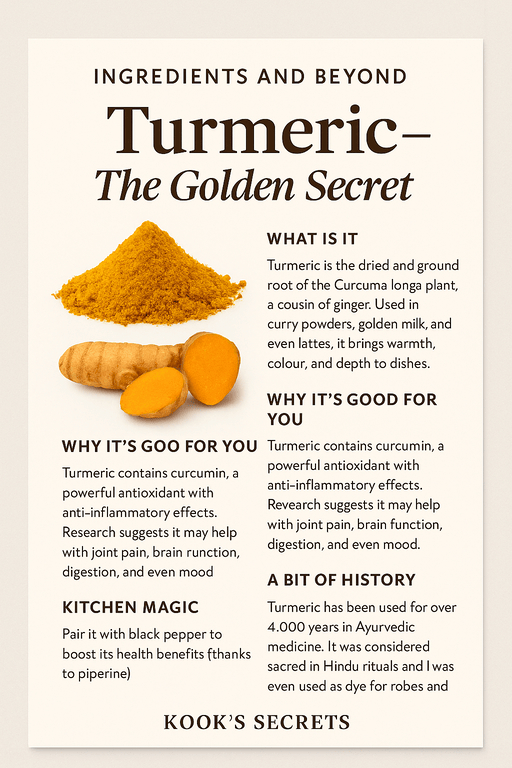

What Is It?
Fresh turmeric rhizomes – the knobbly underground stems of the plant – look a bit like small, stubby ginger roots. Turmeric is indeed a relative of ginger, belonging to the same Zingiberaceae (ginger) family (britannica.com). If you cut or break open a fresh turmeric root, you’ll see a vivid orange flesh inside. (in contrast to its dull brownish skin) (tilda.com). These roots are typically boiled and sun-dried, then ground into the familiar bright yellow-orange powder you find in spice jars. (tilda.com). Turmeric has a peppery aroma and an earthy, slightly bitter taste with a mild gingery warmth (britannica.com). (Be careful when handling it – that brilliant colour can stain fingers and cutting boards a sunny yellow! (britannica.com).
In the kitchen, turmeric is beloved for both its flavour and its colouring power. A pinch can turn rice or curry a golden yellow. This is why it’s a key ingredient in Indian curry powders and pastes. (britannica.com).
It gives American mustard its bright yellow hue. Turmeric is often added to relishes, pickles, and chutneys for colour and depth. (britannica.com). You’ll find turmeric in cuisines from South Asia to the Middle East and beyond. In India, it is practically a daily essential. It is used in lentil dals, vegetable dishes, and spice blends. Millions of people consume it every day as part of their diet. (britannica.com).
Fresh turmeric can also be used. Much like ginger, you can grate or slice the fresh root. Add it into curries, soups, or teas for a more vibrant, citrusy-ginger flavour. (tilda.com). Whether fresh or dried, turmeric adds a warm, bittersweet note and a burst of color to foods.


Why It’s Good for You
Turmeric’s health reputation centers on curcumin, the spice’s main active compound. Modern research is actively investigating curcumin for a range of potential benefits. Here’s a look at why turmeric is touted as so good for you:

Antioxidant All-Star: Curcumin is a potent antioxidant. It scavenges harmful free radicals in the body. These are unstable molecules that can damage cells and DNA. In doing so, curcumin helps protect cells from oxidative stress. (mountsinai.org). In fact, curcumin not only neutralises free radicals directly, it can also boost your body’s own antioxidant defenses. This means including turmeric in your diet will help reduce some of the cell damage linked with aging and diseases. Indeed, lab studies have even looked at curcumin’s potential in preventing cancer, given its ability to protect cells. (mountsinai.org).


Natural Anti-Inflammatory: Turmeric is famously anti-inflammatory. Chronic inflammation is linked to many conditions like arthritis, heart disease, and autoimmune issues. Curcumin appears to help by dampening the inflammatory response. Studies show that curcumin can lower the levels of certain enzymes in the body that cause inflammation .(mountsinai.org). It even acts a bit like a natural pain reliever. Research shows that turmeric extracts have helped reduce joint pain and swelling. These benefits have been observed in people with arthritis. (healthline.com). In one study of osteoarthritis, patients took a curcumin supplement and some other herbal ingredients. They reported less pain and better mobility. (mountsinai.org). While it’s not a cure-all, turmeric’s inflammation-fighting ability is significant. This ability is a big reason it’s used for ailments like arthritis. People also use it for sprains and general aches in traditional medicine.


Brain Booster: There’s exciting interest in turmeric’s neuroprotective potential. In other words, turmeric has the ability to support the brain and nervous system. Curcumin’s antioxidant and anti-inflammatory effects seem to extend to the brain.
These effects may help protect against neurodegenerative diseases like Alzheimer’s and Parkinson’s. (mountsinai.org). Notably, curcumin can cross the blood-brain barrier, which many beneficial compounds cannot. Scientists have observed that populations with high turmeric intake, like in India, have lower rates of Alzheimer’s.
This observation has sparked studies into turmeric’s brain benefits. (newsroom.ucla.edu). Early findings are promising. A clinical trial at UCLA showed that a daily curcumin supplement significantly improved memory and attention.
It boosted these cognitive functions by about 28% in adults aged 50-90 over 18 months. PET scans showed significantly less buildup of Alzheimer’s-related plaques in their brains. (newsroom.ucla.edu). Participants even reported mild mood improvements. While more research is needed, the results are promising. Turmeric may indeed be “food for thought.” It helps to keep our brains sharper as we age.


Digestive Dynamo: Turmeric has been used for centuries to aid digestion. Modern science confirms it can be gentler on your stomach than its peppery taste suggests. Curcumin stimulates the gallbladder to produce bile, which helps break down fats and can improve digestion. (mountsinai.org).
This is one reason turmeric has traditionally been taken to ease bloating, gas and indigestion. In fact, the German Commission E (a scientific advisory board for herbs) has approved turmeric for digestive problems. (mountsinai.org). One placebo-controlled study found that people with dyspepsia (chronic indigestion) had significantly reduced bloating and gas after taking turmeric extract. (mountsinai.org).
Turmeric also soothes inflammatory bowel conditions. In a study of ulcerative colitis, an inflammatory gut disease, patients in remission took curcumin along with their regular medicine. They had a much lower relapse rate than those on medicine alone. (mountsinai.org). However, a note of caution: very high doses of turmeric can upset the stomach. In some cases, it can increase stomach acid. So, more is not always better. In normal culinary amounts, though, turmeric is a gentle friend to your digestion.
(In addition to the above, ongoing research is examining turmeric’s potential benefits. For heart health, diabetes, depression, skin conditions and more. Many of these are still under study, but the general understanding is that turmeric’s anti-oxidant and anti-inflammatory properties. Underpin a lot of its health effects.)


Kitchen Magic
Turmeric isn’t just a supplement or medicine – it’s a delight in the kitchen. This spice can truly work magic in your recipes once you know how to use it. A little goes a long way, both in flavour and colour. Here are some tips and ideas for cooking with turmeric:
Pair it for flavour and absorption
Turmeric’s taste is warm and slightly bitter. It often shines best alongside other complimentary flavours. Cooks love mixing turmeric with other spices like cumin, coriander, ginger or cinnamon to create a balanced, layered taste. (mccormickscienceinstitute.com). One classic tip – always add a pinch of black pepper when you use turmeric. Black pepper contains piperine, a compound that boosts the absorption of curcumin dramatically (by up to 2,000%!).(healthline.com). This peppery partner not only enhances health benefits but also adds a nice bite to turmeric’s mellow bitterness.


Cooking with turmeric
You can use turmeric in countless ways. It’s a cornerstone of Indian curries and masalas, lending dishes a warm aroma and golden colour. It works well in stews, tagines, and chilli – anywhere you want an earthy depth. Sauté a teaspoon with onions and garlic as the flavour base for soups or lentils. Sprinkle a bit into marinades for meat or tofu. Stir it into yoghurt with other spices to make a quick spice rub or sauce. Even Western recipes find uses for turmeric. You can whip it into salad dressings. Stir a dash into mashed potatoes. You can even add a pinch to scrambled eggs. (Pro tip: a tiny amount of turmeric can give homemade pickles or relishes. A vibrant hue, and some chefs even sneak it into macaroni and cheese for a healthy golden tint!)
Golden Milk is a cosy mug of warm milk infused with turmeric and other spices. It represents one of turmeric’s star turns in the beverage world. (mccormickscienceinstitute.com).
This traditional drink is also called haldi doodh or turmeric latte. It combines turmeric with milk, which may be dairy or plant-based. It includes a pinch of black pepper, ginger, and sometimes cinnamon and honey.
Together they create a soothing elixir. Golden milk is cherished as a night-time soother. It is also valued as an immune booster in Indian households.
Think of it as a spiced hot chocolate, but with a wellness twist. You can also blend turmeric into smoothies or juices. Pair it with pineapple or mango for a nice flavour combo. Alternatively, brew it with ginger to make a spicy herbal tea. And don’t forget turmeric’s colour magic. Boil a little in the water for rice or quinoa to turn it sunflower yellow. You can also add it to doughs and batters for a fun visual appeal. Just be mindful that turmeric can stain cookware and clothes, so wash up any spills quickly!
A Bit of History
Turmeric’s story stretches back thousands of years through folklore, food and medicine. It has been used in South Asia for at least four millennia. (mccormickscienceinstitute.com). Archaeologists found traces of turmeric in pots near New Delhi dating to around 2500 BCE. (tilda.com), and ancient Ayurvedic texts from around 500 BCE praise turmeric as a remedy for various ailments. In the Ayurvedic system (India’s traditional holistic medicine), turmeric was used for treating digestive issues. It was also used for throat infections and skin wounds. This use earned turmeric epithets like “Jayanti” meaning “one that wins over diseases”.(ncbi.nlm.nih.gov). Because of its healing reputation, turmeric became known as the “golden spice” or even “the spice of life.”

Tumeric a sacred role in Indian culture
Beyond medicine, turmeric took on a sacred role in Indian culture. For centuries, the Hindu religion has regarded turmeric as auspicious and purifying. (tilda.com). It’s used in religious ceremonies and rituals as a symbol of blessings and good fortune. A vivid example is the haldi ceremony in Indian weddings. A day before the wedding, the bride and groom are bathed in turmeric paste.
This ritual imparts a divine glow to them and protects them from evil. The spice’s bright color symbolizes purity and prosperity. Even on the wedding day, the groom ties a turmeric-dyed thread around the bride’s neck. This thread is known as a mangala sutra, and it symbolises their sacred bond in marriage. (tilda.com). In parts of India, people would wear pieces of dried turmeric root as an amulet. They believed it ward off negativity and illness. This practice underscores its status as a protective charm.
Turmeric’s influence didn’t stop at India’s shores. The spice traveled via trade routes to East and Southeast Asia, the Middle East, and eventually Europe.
By 1280 AD, the Venetian explorer Marco Polo had encountered turmeric in his travels in China. He was impressed. He noted in his diary that there was a vegetable with all the properties of true saffron. These included colour and fragrance. Still, it was not actually saffron. (mccormickscienceinstitute.com).
In medieval Europe, turmeric earned the nickname “Indian saffron.” It was prized as a far cheaper substitute for the rare and costly saffron threads. (mccormickscienceinstitute.com). Europeans mainly used it to impart a yellow color to foods. They used it for textiles as well. This was because its flavor was less familiar to them. Meanwhile, across Asia and Africa, turmeric remained a staple in cooking.
It was used in medicine and served as a natural dye. Buddhist monks, for instance, traditionally dyed their robes with turmeric to achieve that characteristic mustard-yellow-orange hue. (mccormickscienceinstitute.com).
Turmeric also found use as an early food preservative. Long before refrigeration, people discovered that spices could help keep food from spoiling. Turmeric was especially valued for this purpose. Its natural antibacterial and antifungal properties, coupled with its antioxidant effects, helped protect food from germs and decay. (ap.fftc.org.tw). For example, fish or meat might be rubbed with turmeric paste to extend its freshness. Pickles often included turmeric not just for color or flavor but to inhibit mold and bacteria. This preservative role made turmeric indispensable in pre-modern kitchens. It also had the ability to make foods look more appetising.
Turmeric has journeyed through history as a beloved spice. It has been used by ancient Ayurvedic healers and Hindu priests. Global chefs and modern scientists also revere it. Its vibrant color, distinct taste, and healthful properties have woven it into the fabric of daily life and ritual. It’s no wonder this humble root is celebrated as a source of flavour, wellness, and cultural richness. It is one of nature’s best-kept secrets and is finally getting the recognition it deserves in our time.

Sources:
FFTC Agricultural Platform – “Turmeric and Annatto as Natural Food Colorants and Preservatives”ap.fftc.org.tw.
Bharat B. Aggarwal & Sahdeo Prasad (2011). “Turmeric, the Golden Spice: From Traditional Medicine to Modern Medicine.” Herbal Medicine: Biomolecular and Clinical Aspects (2nd ed.). (pubmed.ncbi.nlm.nih.gov.)
Mount Sinai Medical Center – Turmeric (Herb Info).(mountsinai.org.)
Britannica – Turmeric: Description, Uses & History.(britannica.combritannica.com).
McCormick Science Institute – Turmeric Profile.(mccormickscienceinstitute.com)
UCLA Newsroom – “Curcumin improves memory and mood, new UCLA study says”(newsroom.ucla.edu).
Healthline – “Why Turmeric and Black Pepper Is a Powerful Combination”(healthline.com).
Tilda Rice (Blog) – “A Guide to Turmeric”(tilda.com).
FFTC Agricultural Platform – “Turmeric and Annatto as Natural Food Colorants and Preservatives”
